
Updated
Entry-Level Resume Guide (2026): No Experience? Here's What to Do
Everyone starts somewhere. Your first real resume doesn't need years of experience — it needs the right structure, the right content, and the right approach. This guide covers exactly what to include when you're just starting out.
What to Include in Your Entry-Level Resume
Entry-level resumes have a different optimal structure than experienced-hire resumes. Follow this order:
Contact Information
Required- Full legal name (large and bold)
- Professional email: firstname.lastname@gmail.com — never a nickname or old school address
- Phone number with area code
- City and State (no full address)
- LinkedIn URL (customized: linkedin.com/in/your-name)
- GitHub, portfolio site, or Behance — include if you have relevant work
Education
Lead with this- University name, city, state
- Degree type and major: 'B.S. in Computer Science' not just 'Computer Science'
- Graduation date (month and year)
- GPA: include only if 3.5 or above — e.g., 'GPA: 3.8/4.0'
- Dean's List, honors, academic awards
- Relevant coursework (for technical roles especially): list 4–6 courses that match the JD
- Study abroad if relevant to the role (especially international companies or language-relevant roles)
Relevant Experience
Internships first- Internships — even unpaid ones count and should be listed just like a job
- Co-op programs and part-time work in your field
- Research assistant or lab work for academic/technical roles
- Freelance projects (design, code, writing) with real clients
- Campus jobs with transferable skills (tutoring = communication + expertise; RA = leadership + conflict resolution)
- Part-time retail/service jobs can be included — emphasize customer service, cash handling, or team collaboration
Projects
Critical for new grads- Academic capstone, senior thesis, or class projects relevant to your field
- Personal projects: apps you built, reports you wrote, analyses you ran
- Open source contributions with links to the commits or PRs
- Hackathon projects: include the challenge, your solution, and the result (placed? won? built in 24hrs?)
- Each project entry: project name, 2–4 bullets using action verbs + quantification, link if publicly available
Skills
Required- Hard skills only — soft skills go in your bullets and summary, not a listed category
- Group by type: Programming Languages, Tools & Frameworks, Data & Analytics, Design Tools, etc.
- List skills by proficiency order within each group: strongest first
- Only list skills you can speak to in an interview — overstating gets exposed
- Include relevant certifications inline with skills: 'Google Analytics (Certified)', 'AWS (Associate Certified)'
Activities & Leadership
Valuable for new grads- Student clubs, especially leadership roles: VP, Treasurer, Event Chair
- Varsity or competitive sports — signals discipline, teamwork, performance under pressure
- Greek life leadership roles (chapter president, risk management chair)
- Volunteer work, especially sustained involvement (not one-off events)
- Competitions: case competitions, debate, Model UN, hackathons
Entry-Level Resume Summary Examples
Skip the outdated objective statement. Open with a 2–3 line summary that says what you offer, not what you want. Adapt one of these to your situation, or browse more objective and summary examples:
“Marketing graduate (B.B.A., 3.7 GPA) with hands-on campaign experience from two internships and a student-run agency. Grew a campus organization's Instagram following 40% in one semester. Seeking to apply content and analytics skills (Google Analytics certified) to a junior marketing role.”
“Reliable and fast-learning high school graduate with a record of academic commitment and volunteer leadership. Organized weekly food-bank shifts for a 15-person volunteer team. Known for showing up early, following through, and learning new systems quickly. Seeking a first customer-facing role.”
“Computer science graduate with 4 deployed personal projects, including a full-stack budgeting app (React, Node.js, PostgreSQL) with 300+ users. Contributor to two open-source repositories. Seeking a junior developer role where shipped code matters more than years logged.”
“Former retail team lead transitioning into data analytics after completing the Google Data Analytics Certificate. Built 5 portfolio dashboards in Tableau and SQL, including a sales analysis that mirrored real inventory problems managed on the job. Combines proven customer insight with new technical skills.”
6 Entry-Level Resume Myths (Busted)
Bad advice circulates widely. Here's what to ignore:
You need 3–5 years of experience to apply
The '3–5 years of experience' in an entry-level job posting is a wish list, not a hard requirement. Apply if you meet 60–70% of the qualifications. Many postings are written by HR teams copying templates, not actual hiring managers.
Your resume should be 2 pages
Entry-level resumes must be exactly 1 page. Hiring managers spend seconds on first-pass reviews. One focused page forces you to include only your strongest material and signals that you understand professional norms.
An objective statement goes at the top
Objective statements ('Seeking a challenging role where I can grow') are outdated and add zero value. Replace with a 3-line professional summary that focuses on what you bring to the role, not what you want from it.
List every job you've ever had
Babysitting from high school and the summer job you held for 3 weeks don't belong. Include jobs with transferable skills. Quality over quantity — a focused, relevant 1-pager beats a cluttered 2-pager.
Avoid gaps by listing years only
Using just years (2023–2024) instead of month-year hides gaps but raises red flags. Be honest and fill gaps with real content: freelance work, certifications, personal projects, or a brief note in your summary.
A creative, designed resume stands out
Most creative resume formats fail ATS parsing and confuse recruiters. A clean, well-structured, ATS-safe resume beats a visually complex one almost every time unless you're in a design-heavy creative role.
How to Write Bullets with No Experience
You have more to write about than you think. Here's how to transform everyday tasks and academic projects into compelling resume bullets:
“Helped customers find products”
“Assisted 50+ customers daily in product selection, contributing to 15% above-average satisfaction scores in quarterly surveys”
“Did data analysis for a marketing project”
“Analyzed 10,000-row customer dataset in Python (Pandas) to identify 3 key churn drivers; presented findings to a panel of 4 faculty judges”
“Organized events for the marketing club”
“Planned and executed 6 networking events for the 120-member Marketing Club, averaging 85% attendance and securing $1,200 in sponsorships”
“Assisted with social media posts”
“Created and scheduled 30+ social media posts per month across Instagram and LinkedIn; contributed to 22% follower growth over 3-month internship”
“Helped professor with research”
“Collected and coded 500+ qualitative survey responses for NIH-funded study on adolescent health behaviors; findings contributed to 2 published papers”
Skills to Include on an Entry-Level Resume
The rule: hard skills go in the skills section, soft skills go in your bullets. Recruiters skip skills lists full of “team player” — but they search for tools and technologies by name. Not sure which keywords a job wants? Paste the posting into our resume keyword scanner.
Universal hard skills (almost any office role)
Technical roles
Customer-facing roles
Put these in bullets, not the skills list
What Entry-Level Recruiters Look For (By Industry)
Different industries care about completely different things. Tailor your resume accordingly:
Software Engineering
- GitHub portfolio link with active repos
- Languages and frameworks listed precisely (React not 'JavaScript frameworks')
- 2–4 personal or academic projects with live links
- Contributions to open-source (even small ones)
Marketing & Communications
- Portfolio link with writing samples, campaigns, or design work
- Any analytics exposure: Google Analytics, Meta Ads, HubSpot
- Metrics on any content you created (reach, engagement, conversions)
- Blog, newsletter, or social account you manage
Finance & Accounting
- Excel proficiency (specify: VLOOKUP, pivot tables, Power Query)
- Relevant coursework: Financial Modeling, Corporate Finance, Accounting
- Bloomberg or financial databases if used in classes
- Any certifications: CFA Level 1, Bloomberg Essentials
Healthcare & Sciences
- Lab techniques and equipment by name
- Research experience with publication or poster links
- Clinical hours logged (pre-med, nursing)
- EMR/EHR systems if applicable
Design (UX/UI, Graphic)
- Portfolio URL — this is more important than your resume itself
- Tools listed precisely: Figma, Sketch, Adobe XD, Photoshop, Illustrator
- Design process description in project bullets
- Case studies if possible
Entry-Level Resume Example (No Experience)
Here's what it looks like assembled — a complete first-job resume built entirely from school, volunteering, and projects. Writing your very first resume for a part-time or retail job? See the dedicated resume with no experience guide. For role-specific versions, see our full resume examples library.
Motivated high school graduate with a record of academic commitment and volunteer leadership. Organized weekly food-bank shifts for a 15-person volunteer team and maintained a 3.8 GPA while working toward a customer service career. Fast learner with proven reliability.
- GPA: 3.8/4.0 · National Honor Society
- Relevant coursework: Business Fundamentals, Public Speaking, Statistics
- Coordinate weekly shifts for a 15-person volunteer team serving 200+ families per week
- Trained 8 new volunteers on intake procedures and food-safety standards
- Recognized as Volunteer of the Month twice for reliability and initiative
- Treasurer, DECA Club — managed a $2,000 annual budget and event registrations for 30 members
- Built a budgeting spreadsheet template in Google Sheets adopted by the club for 3 fundraisers
Google Workspace (Docs, Sheets, Slides) · Microsoft Excel · Canva · Cash handling (trained) · Spanish (conversational)
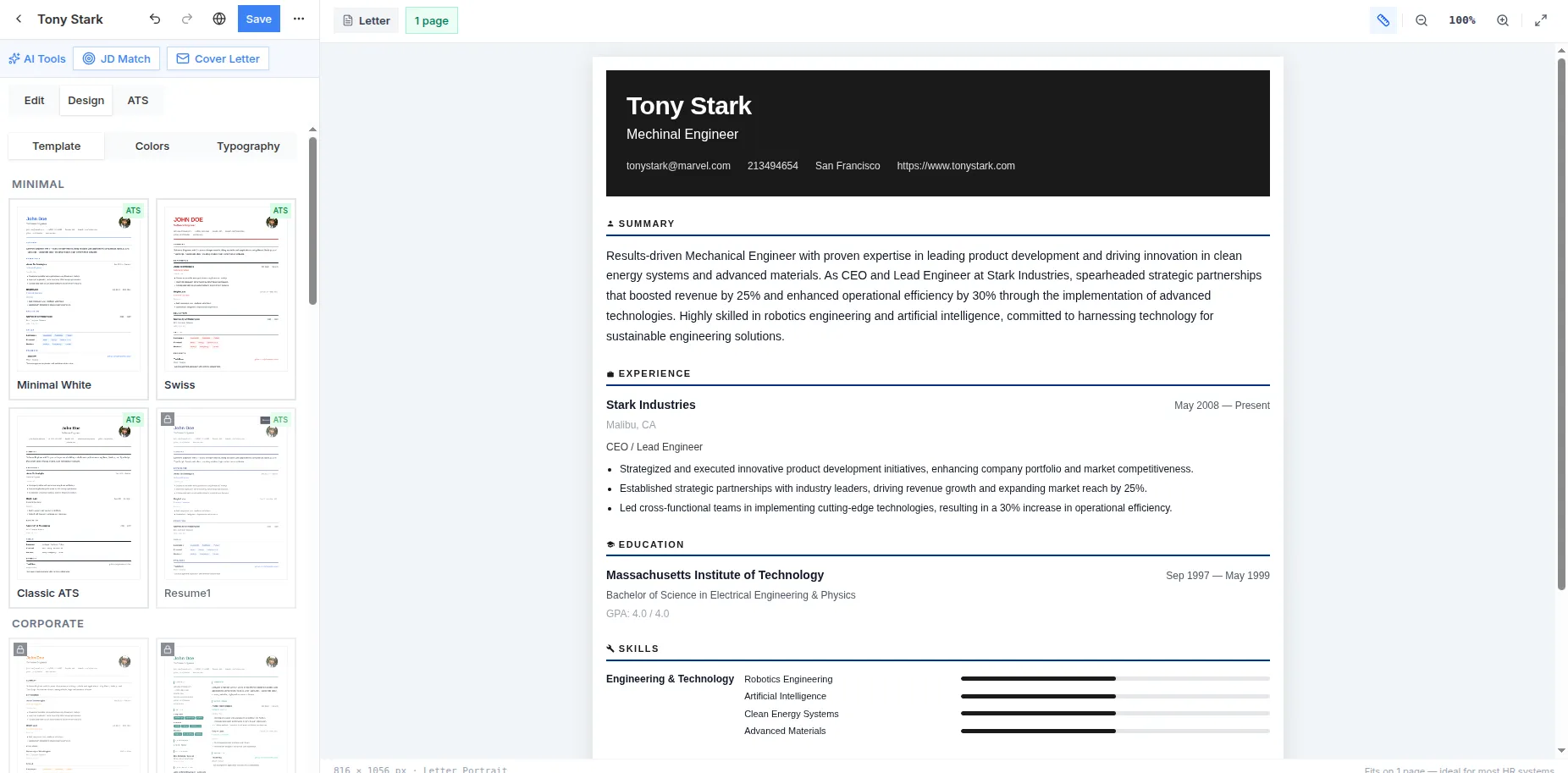
Real screenshot from the live app — sign in free and build yours
Entry-Level Resume FAQ
How do you write a resume with no experience?
Lead with education, then build the middle of the page from projects, coursework, volunteering, and campus or community activities — each written with action verbs and numbers, exactly like job bullets. Add a skills section with hard skills only and a 2–3 line summary at the top. A no-experience resume is one page, and every line should answer: what did I do, and how did it matter?
What skills should I put on an entry-level resume?
List hard skills you can demonstrate in an interview: software (Excel, Canva, a POS system), technical skills (Python, SQL, Figma), languages, and certifications. Leave soft skills like communication and teamwork out of the skills list — show them inside your bullet points instead, where they carry evidence.
How long should an entry-level resume be?
Exactly one page. Recruiters spend about 7 seconds on a first pass, and a one-page resume signals you know professional norms. If you're spilling onto page two with under 3 years of experience, cut the weakest content rather than shrinking the font.
Should an entry-level resume have a summary or an objective?
Use a summary, not an objective. An objective states what you want; a summary states what you offer — your degree, strongest skills, and one concrete achievement in 2–3 lines. Every example on this page follows that pattern.
Do I need a different resume for every application?
You need one strong base resume, then 5–10 minutes of tailoring per application: swap keywords to match the job description, reorder skills, and adjust your summary's last line to name the role. Run the job description through a keyword scanner to see which terms to mirror.
The One Rule for Entry-Level Resumes
Every bullet point should answer: “What did I do, and how did it matter?” If you can't answer both parts, rewrite the bullet or cut it.
Build your first professional resume
One Simple Resume's entry-level templates are ATS-optimized and designed specifically for recent graduates and first-time job seekers.