
Glossary
Resume & Job Search Glossary
Plain-language definitions for 27 terms you'll run into while writing a resume and applying for jobs — from ATS to the STAR method. Each definition links to a full guide if you want more depth.
Action Verb (Resume)ATS (Applicant Tracking System)Boolean Search (Recruiting)Chronological ResumeCombination ResumeCover LetterCV (Curriculum Vitae)Elevator PitchFunctional ResumeHard SkillsKeyword StuffingLinkedIn HeadlineQuantifiable AchievementRecruiter ScreenResume Gap (Employment Gap)Resume LengthResume MarginsResume ObjectiveResume ParsingResume SummaryResume TailoringReverse-Chronological OrderSingle-Column ResumeSoft SkillsSTAR MethodTransferable SkillsWhite Space (Resume Design)
- Action Verb (Resume)
- A strong verb used to open a resume bullet point — such as 'Led', 'Built', 'Reduced', or 'Negotiated' — in place of passive phrasing like 'Responsible for.' Action verbs signal ownership and make bullets easier to scan quickly. 450+ resume action verbs
- ATS (Applicant Tracking System)
- Software employers use to collect, sort, and filter job applications before a human recruiter sees them. An ATS scans resumes for keywords, parses them into structured fields (name, experience, skills), and often ranks or filters candidates before manual review. Full ATS guide
- Boolean Search (Recruiting)
- A search technique recruiters use in an ATS or LinkedIn to find candidates, combining keywords with operators like AND, OR, and NOT — for example, '("software engineer" OR "backend developer") AND Python.' Matching the exact phrasing recruiters commonly search for improves resume discoverability.
- Chronological Resume
- A resume format that lists work experience in reverse order, most recent job first. It is the most common and most ATS-friendly format, and the default recommendation for most job seekers with a fairly continuous work history. Resume format guide
- Combination Resume
- A hybrid format that opens with a skills-based summary and follows with a reverse-chronological work history. Common for career changers, who need relevant skills to lead while still showing an honest, verifiable timeline. Resume format guide
- Cover Letter
- A one-page letter submitted alongside a resume that explains why a candidate is applying to a specific role and company, connecting their background to the position in narrative form rather than the resume's bullet-point format. Cover letter writing tips
- CV (Curriculum Vitae)
- In the US and Canada, a comprehensive, multi-page document used primarily for academic, research, and medical positions, listing publications, grants, and teaching history in full. In the UK, Ireland, and much of Europe, 'CV' is simply the standard term for what Americans call a resume. CV vs resume explained
- Elevator Pitch
- A concise, roughly 30-second verbal summary of who you are professionally and what you're looking for — used in networking, interviews, and the classic 'tell me about yourself' opener. Often mirrors the same content as a resume summary, adapted for speech. Job search tips
- Functional Resume
- A resume format organized around skill categories rather than a chronological work history. Used to de-emphasize employment gaps or a non-linear career, though many recruiters and ATS systems handle it less reliably than a chronological format. Resume format guide
- Hard Skills
- Specific, teachable, and typically measurable abilities — a programming language, a certification, proficiency with a piece of software, a foreign language. Hard skills are what most ATS keyword matching is built around. Resume skills guide
- Keyword Stuffing
- Overloading a resume with job-related keywords — often as a hidden list or in unnatural repetition — in an attempt to manipulate ATS keyword matching. Modern ATS systems and human reviewers both penalize this; keywords should appear naturally within real accomplishments. Resume keywords guide
- LinkedIn Headline
- The short line of text under your name on LinkedIn, shown in search results and connection requests. Defaults to your current job title but can be customized to include keywords, specialization, or value proposition for better discoverability. LinkedIn profile tips
- Quantifiable Achievement
- A resume bullet point that includes a specific, measurable result — a percentage, dollar amount, time saved, or count — rather than a general description of duties. Quantified bullets are consistently rated as more credible and persuasive by recruiters. Resume writing tips
- Recruiter Screen
- An initial phone or video call, typically 20–30 minutes, where a recruiter verifies basic qualifications, discusses compensation expectations, and gauges interest before advancing a candidate to hiring-manager or panel interviews. Interview tips
- Resume Gap (Employment Gap)
- A period of time on a resume with no listed employment. Common causes include caregiving, education, health, layoffs, or career transitions. Gaps are increasingly normalized in hiring and are best addressed briefly and honestly rather than hidden through resume format tricks.
- Resume Length
- How many pages a resume runs. One page is standard for under roughly 10 years of experience; two pages is acceptable beyond that or in fields expecting more detail (senior leadership, academia, federal applications). How long should a resume be
- Resume Margins
- The blank space around the edges of a resume page, typically between 0.5 and 1 inch. Margins that are too narrow crowd the page; margins that are too wide waste space that could hold content on a length-constrained one-page resume.
- Resume Objective
- A one- to two-sentence statement near the top of a resume describing the type of role a candidate is seeking. Largely replaced by the resume summary in modern resumes, though still used by entry-level candidates and career changers to state direction clearly. Resume objective examples
- Resume Parsing
- The process an ATS uses to extract structured data — name, contact info, job titles, dates, skills — from a resume file. Parsing works best on single-column, text-based documents; tables, text boxes, and multi-column layouts often parse incorrectly or drop content entirely. Full ATS guide
- Resume Summary
- A brief paragraph near the top of a resume — typically two to four sentences — summarizing a candidate's experience level, core strengths, and most relevant achievements. Written for someone with existing experience, unlike an objective statement. Resume summary examples
- Resume Tailoring
- Customizing a resume's content, emphasis, and keywords for a specific job posting rather than sending an identical resume to every application. Tailoring typically means reordering bullets, adjusting the summary, and matching language from the job description. How to write a resume
- Reverse-Chronological Order
- Listing experience, education, or any dated history starting with the most recent entry and working backward. The standard convention for resume work history sections, and the order ATS systems are built to expect. Resume format guide
- Single-Column Resume
- A resume layout where all content flows in one vertical column, read top to bottom. The most reliably ATS-parseable structure, since it avoids the reading-order ambiguity that multi-column and sidebar layouts can create for parsing software. Full ATS guide
- Soft Skills
- Interpersonal and behavioral traits — communication, leadership, adaptability, collaboration — that are harder to measure directly. Best demonstrated on a resume through specific examples and outcomes rather than listed as standalone words. Resume skills guide
- STAR Method
- A framework for structuring interview answers and resume bullets: Situation, Task, Action, Result. Used most often to prepare behavioral interview responses, but the same structure — context, action taken, measurable outcome — strengthens resume bullets too. Interview tips
- Transferable Skills
- Abilities developed in one role or industry that apply directly to a different one — for example, de-escalation skills from customer service transferring to healthcare, or budget management from event planning transferring to operations. Career change resume guide
- White Space (Resume Design)
- The empty, unmarked area of a resume page between text, sections, and margins. Sufficient white space improves readability and scan speed; too little makes a resume feel dense and harder to read even when the content is strong.
Live App Screenshot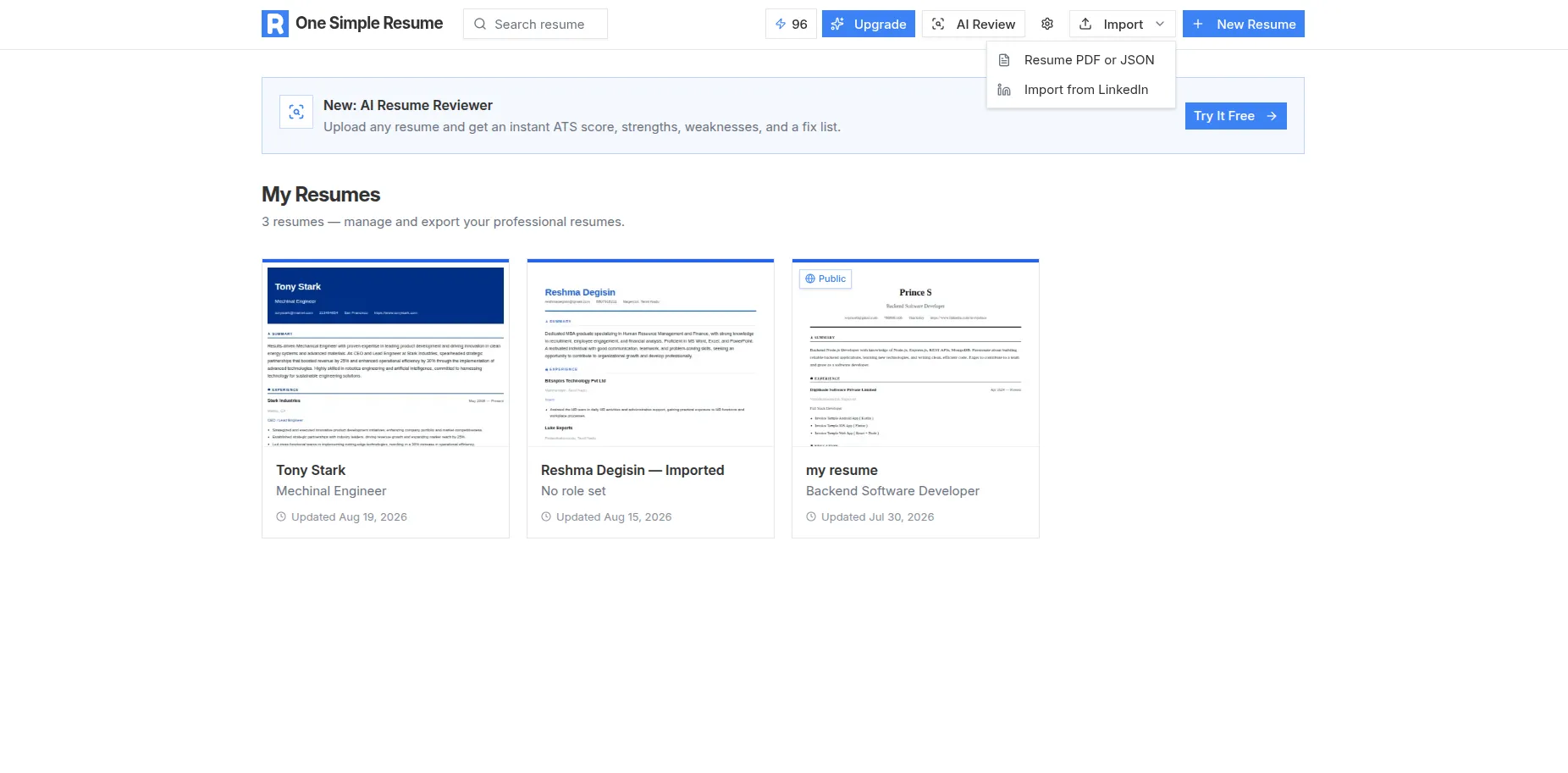
Real screenshot from the live app — sign in free and build yours
Put It Into Practice
Now that the terminology is clear, build a resume that actually applies it — free, ATS-checked, no account needed.