
Updated
Entry-Level Financial Analyst Resume: What Actually Works
Finance is a field where you can build proof of skill before anyone hires you — models, valuations, dashboards, and competition pitches. This guide shows how to turn those into a resume that gets analyst interviews without full-time experience, with a complete example to copy.
What Counts as Analyst Experience (Before Your First Analyst Job)
Hiring managers screening entry-level finance resumes look for evidence you can already build, check, and explain numbers. All of these count:
The finance equivalent of a coding portfolio. Build and document a three-statement model, a DCF valuation of a real public company, or a budget-vs-actuals dashboard. Write each up like a job: the company analyzed, the methods used (comparable companies, sensitivity tables), and the conclusion you defended. Link a sanitized copy from your resume header.
A summer in accounting, banking operations, or even a small business's back office counts. Frame the analyst-shaped work: reports you automated, reconciliations you owned, data you cleaned and presented. One quantified bullet ('automated a weekly KPI report, saving 3 hours per week') outweighs a list of duties.
'CFA Level I candidate — exam scheduled Nov 2026' is a legitimate resume line that signals seriousness. Passed is stronger. Alternatives with real hiring weight: FMVA (financial modeling), Bloomberg Market Concepts (BMC), and a Microsoft Excel Expert certification. One credential plus a documented model beats five course-completion badges.
CFA Research Challenge, stock-pitch competitions, a student-managed investment fund, finance-club valuation projects. These are team deliverables under deadline with a defended conclusion — exactly the analyst job. Include placement if you ranked, and the ticker/thesis if you pitched.
Not the course list — the outputs. A capstone valuation, an econometrics project with a real dataset, a corporate-finance case series. Two or three with one bullet each, focused on the tools (Excel, SQL, Python, Power BI) and the finding.
Which Credentials Belong on an Entry-Level Finance Resume
Priority order for a first analyst role:
The strongest entry-level finance signal. Even 'candidate' status with a scheduled exam date differentiates you; a pass moves your resume up the stack.
Practical modeling credential — best paired with the actual models it taught you to build. Faster and cheaper than the CFA; well recognized in FP&A and corporate finance.
A weekend-scale certificate that signals market literacy. Most useful for markets-facing and research roles; many university Bloomberg terminals include it free.
Excel is the actual job at entry level. A formal certification plus named skills (XLOOKUP, pivot tables, Power Query) beats 'proficient in Excel.'
Not required, but increasingly the differentiator for FP&A and data-heavy analyst seats — one course plus one project using a real dataset is enough to list both.
Entry-Level Financial Analyst Resume Example
A complete analyst resume built from one internship, modeling projects, and credentials — no full-time employment on it:
Finance graduate (B.S., May 2026) and CFA Level I candidate seeking an FP&A or corporate finance analyst role. Built a full three-statement and DCF model of a mid-cap industrial for the CFA Research Challenge (regional finalist) and automated weekly KPI reporting during a corporate accounting internship, saving the team 3 hours per week.
- Built a three-statement model with DCF and comparable-company valuation; defended a HOLD thesis to a judging panel of practitioners — regional finalist among 14 universities
- Ran sensitivity tables on WACC and terminal growth; presented a one-page output the panel called “desk-ready”
- Modeled a 40-store retailer's P&L with scenario toggles (traffic, ticket, labor %) in Excel using Power Query and SUMIFS-driven summaries; documented assumptions in a readme
- Automated a weekly operations KPI report in Excel (Power Query + pivot tables), cutting preparation from 4 hours to 1 — the template remained in use after the internship
- Supported month-end close: prepared 30+ account reconciliations and investigated variances over threshold with plain-language explanations for the controller
- CFA Level I candidate (exam Nov 2026) · Bloomberg Market Concepts (2025)
- Relevant coursework: Corporate Finance, Financial Statement Analysis, Econometrics
Excel (XLOOKUP, pivot tables, Power Query, sensitivity tables) · Financial modeling (3-statement, DCF, comps) · Power BI · SQL basics · Bloomberg Terminal · Variance analysis
Financial Analyst Resume Keywords That Get Past the ATS
Mirror the exact terms from each job posting — these are the ones entry-level analyst descriptions use most. Check your match rate with the resume keyword scanner:
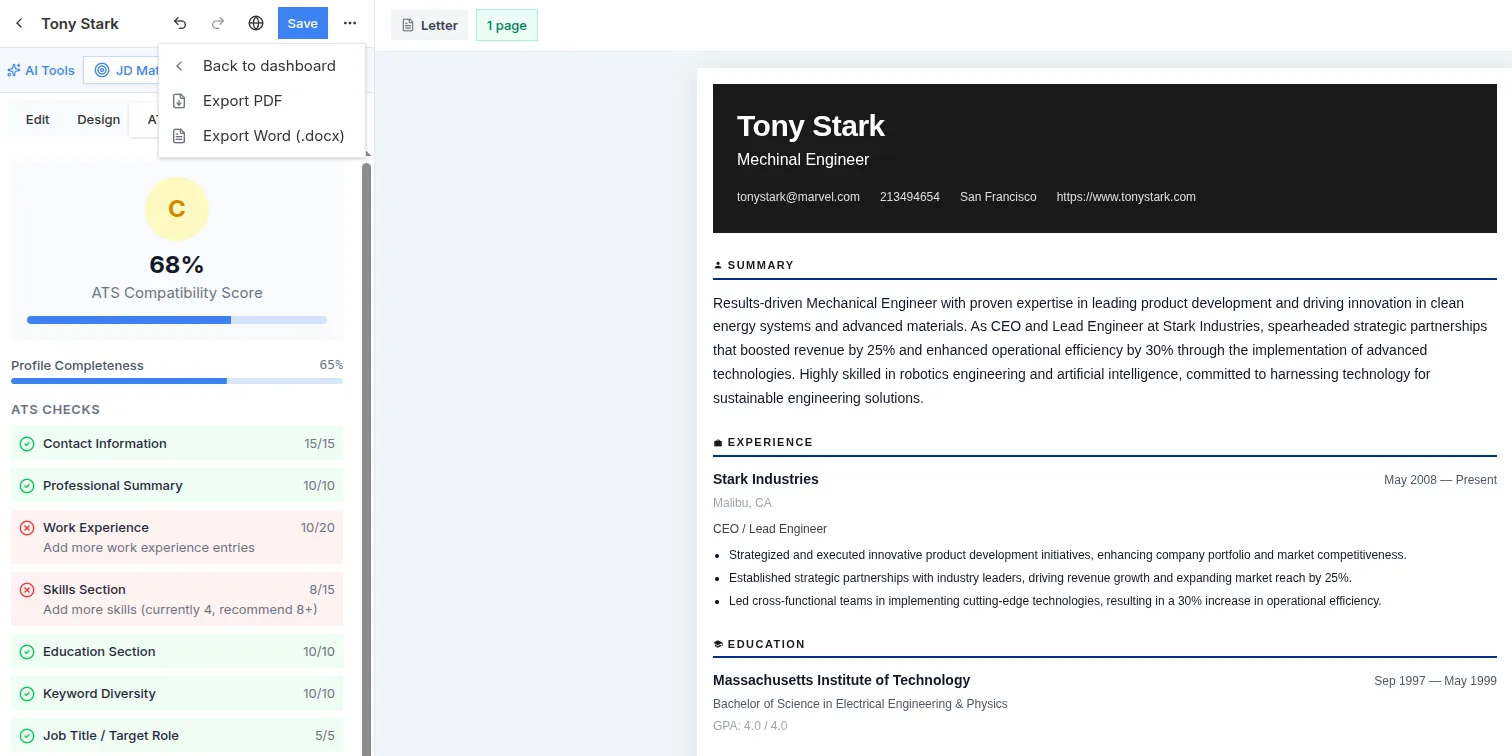
Real screenshot from the live app — sign in free and build yours
Entry-Level Financial Analyst Resume FAQ
How do I write a financial analyst resume with no experience?
Structure it as: contact info, a 2–3 line summary naming your degree, strongest credential, and best project; then a Projects section with modeling work written in job-style bullets; then internships and any work history; then education with relevant coursework; then a skills section naming exact tools. Lead with evidence you can already do analyst work — models, dashboards, competitions — rather than apologizing for missing job history.
Is CFA Level I worth putting on an entry-level resume?
Yes, even as a candidate. 'CFA Level I candidate (exam Nov 2026)' signals commitment and baseline knowledge, and recruiters filter for it in markets-facing roles. Once passed, list it in your summary line as well as the certifications section.
What Excel skills does an entry-level financial analyst need?
Name specifics, not 'proficient in Excel': XLOOKUP/INDEX-MATCH, pivot tables, Power Query, conditional aggregation (SUMIFS), and building sensitivity tables. If you can, prove them in a project bullet — 'built a driver-based forecast model with scenario toggles' does more than any skills list.
Do financial modeling projects count as experience?
For entry-level roles, yes — they're the closest thing to a work sample the hiring manager can check. A documented DCF of a real company, with your assumptions stated and a one-page output, regularly gets discussed in interviews. Present each model like a job entry: what you built, the method, and the conclusion.
Should an entry-level finance resume be one page?
Always. Analyst hiring runs on fast screens of large applicant pools, and a second page with no work history signals padding. One dense page — summary, projects, internships, education, skills — is the format every bank and corporate finance team expects.
Build your analyst resume now
Clean, ATS-safe templates that put projects and credentials where finance recruiters look first. Free, no account needed.