
Updated
Resume & Hiring Statistics 2026
Job-search advice is full of recycled numbers nobody traces back to a source — starting with the infamous “75% of resumes are rejected by ATS.” Every figure on this page is dated, attributed, and linked to where it actually came from.
The Myth We're Debunking First
The claim that "75% of resumes are rejected by ATS before a human sees them" is one of the most repeated numbers in job-search content — and it traces back to a company that closed in 2013. A 2025 study across 25 recruiters and 10+ ATS platforms found only 8% enable any form of content-based auto-rejection; the rest rely on human review guided by hard "knockout" requirements (like work authorization or minimum years of experience) that the employer sets, not an algorithm scoring your resume. The real barrier to getting seen isn't a robot — it's application volume.
Source: Traced and reported by unchartedcareer.com and The Interview Guys (2025 investigation)How Recruiters Actually Read a Resume
TheLadders' eye-tracking study — first run in 2012, updated in 2018 — found recruiters spend an average of 7.4 seconds on the initial scan of a resume, up slightly from 6 seconds in the original study. About 80% of that time goes to name, current and previous titles, employment dates, and education.
Source: TheLadders Eye-Tracking Study (2012, updated 2018)Typos remain one of the fastest ways to lose a hiring manager, independent of ATS. Surveys on this range from roughly 59% to 77% depending on methodology and year, but they consistently point the same direction: proofread before you submit, and don't rely on a spell-checker alone.
Source: CareerBuilder survey, discussed by Dr. John Sullivan / ERE (industry-cited)Resume Length: The 2025 Shift
A 2025 survey of 1,013 HR professionals found 82.1% consider 1–2 pages the ideal length, and for the first time a plurality — 51% — specifically prefer two pages over one. Two-page resumes scored 21% higher for "providing a comprehensive summary of the candidate" and recruiters spent roughly twice as long reading them.
Source: ERE.net, "New Survey Declares Winner in One-Page vs. Two-Page Resume Debate" (2025 survey)AI in Hiring
SHRM's survey of 2,040 HR professionals found AI usage in HR functions jumped to 43% in 2025, up from 26% the year before — one of the sharpest year-over-year increases SHRM has tracked. That doesn't mean 43% of resumes are being auto-rejected by AI; most of that usage is sourcing candidates and drafting communications, not making reject/advance decisions unsupervised.
Source: SHRM survey, reported by NYSSCPA (2025 survey of 2,040 HR professionals)The Job Search Market
Applications per posting jumped from an average of 207.2 in 2024 to 257.6 in 2025, as employers pull from deeper, more accessible talent pools. That volume — not a rejection algorithm — is the real reason a single application rarely gets a response: recruiters are triaging hundreds of resumes for every role.
Source: Employ 2025 Hiring Benchmarks Report, via HR Dive (2025 report)LinkedIn & Networking
Most current surveys put recruiter LinkedIn usage above 85%, with several reporting figures in the 90s — making it the dominant sourcing channel alongside direct applications. On the candidate side, roughly 9 in 10 job seekers report using LinkedIn regularly during a search.
Source: Zippia LinkedIn Statistics roundup (2025–2026 compiled data)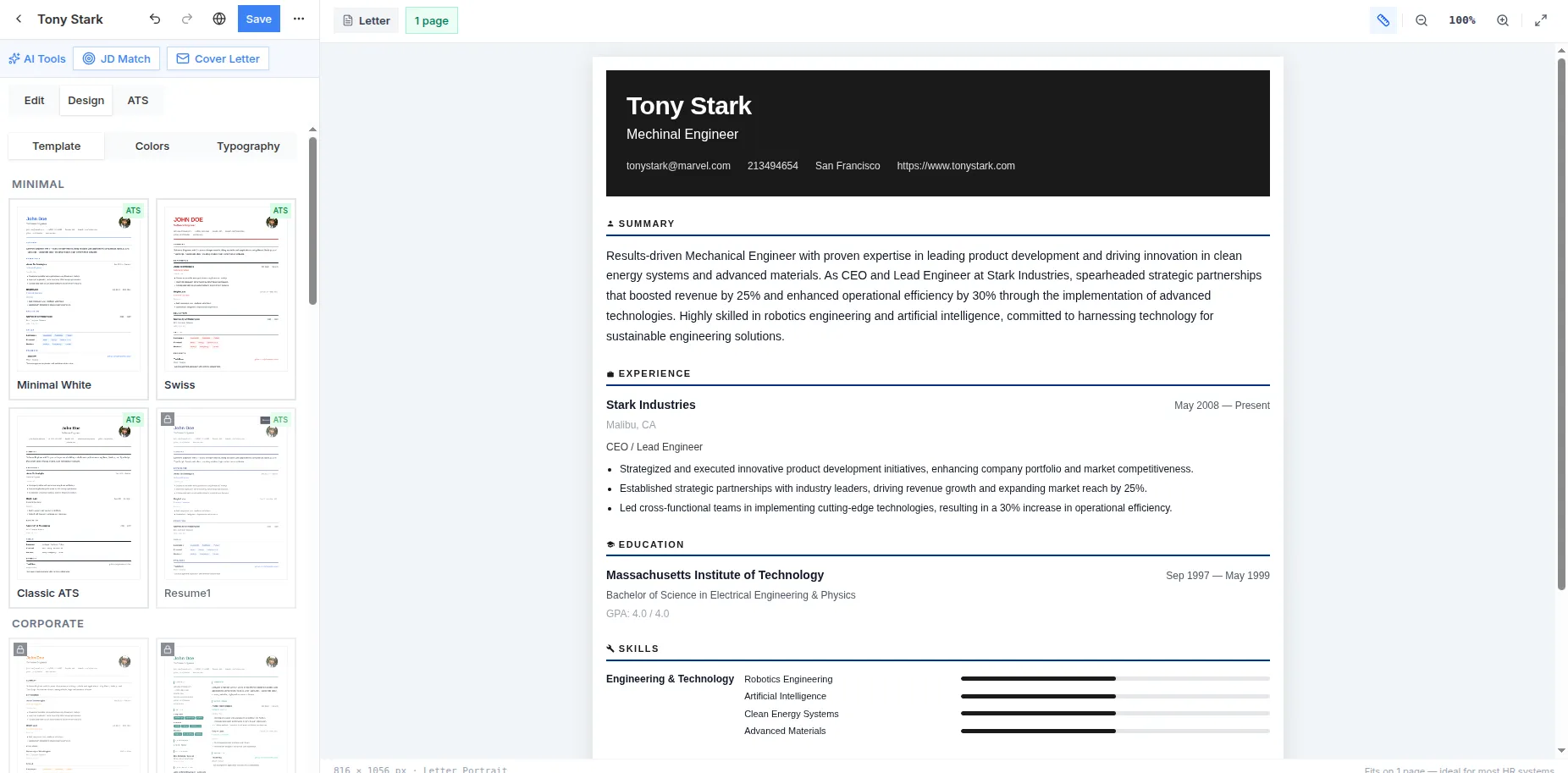
Real screenshot from the live app — sign in free and build yours
FAQ
Is it true that 75% of resumes are rejected by ATS before a human sees them?
No — this is one of the most persistent myths in job-search advice. It traces back to a company that closed in 2013, and current research (a 2025 study across 25 recruiters and 10+ ATS platforms) found only 8% of ATS setups use any content-based auto-rejection. Most "filtering" is actually humans triaging huge volumes of applications, guided by hard requirements the employer sets — not an algorithm silently discarding well-qualified resumes.
Does that mean ATS formatting doesn't matter?
It still matters — just for a different reason than the myth suggests. Your resume still needs to parse cleanly so a recruiter's search and the ATS's structured fields show your real experience correctly. The risk isn't a robot auto-rejecting you on keyword count; it's a garbled parse making you look less qualified than you are, or a genuinely missing hard requirement (like work authorization) triggering a real knockout.
Should my resume be one page or two?
The data has shifted: as of 2025, a narrow majority of HR professionals (51%) now prefer two pages, and 82% consider 1–2 pages acceptable. One page is still the safer default under about 5 years of experience; two pages is now mainstream, not a mistake, for anyone with a fuller career history.
How many applications does it typically take to get an interview?
With average postings drawing over 250 applications in 2025 (up from ~207 in 2024), most sources report roughly 4–6 candidates out of every 250 applicants get an interview. This is why volume and tailoring both matter — a generic resume competing against 250 others needs every edge it can get.
A note on these numbers: every statistic above links to the survey, study, or report it comes from. Where multiple surveys report different figures for the same question (typo rejection rates, for example), we've noted the range rather than picking whichever number sounds most dramatic. Statistics from third-party surveys reflect that survey's own methodology and sample — treat them as directional evidence, not universal law, and check the source link if a figure matters to a decision you're making.
Now Build a Resume That Actually Gets Read
Formatting still matters — just not for the reason the myths say. Every One Simple Resume template parses cleanly and exports to PDF. Free, no account needed.