
Updated
50 Interview Tips to Land the Job (2026)
Most candidates prepare for the wrong things. These 50 tips cover every phase of the interview process — from deep company research and behavioral questions to salary negotiation and follow-up emails that actually convert.
10 Questions You Will Always Be Asked
Prepare structured answers to these before every interview:
The weakness question trips up more candidates than any other on this list — see our dedicated greatest weakness answer guide with 15 sample answers and the clichés to avoid.
Before the Interview
Preparation wins interviews — execution is just execution
Go beyond the homepage. Read their latest earnings call or press release, recent news articles, Glassdoor reviews, and LinkedIn profiles of your interviewers. Know their mission, recent product launches, and cultural values cold.
Print it out. Circle every requirement. Match each one to a specific story from your experience. Anything listed in the first three bullets of a JD is a top priority — prepare a detailed example for each.
Most interviews run on the same 10–15 questions. Build a bank of versatile stories using the STAR format (Situation, Task, Action, Result) that you can adapt to any behavioral question.
Situation (brief context), Task (your specific role/challenge), Action (what YOU did — not 'we'), Result (quantified outcome). Practice each story in under 2 minutes.
This is your opening pitch. Structure it: where you came from → what you've built → why this role excites you. Keep it to 90 seconds. Memorize it — not word-for-word, but deeply practiced.
Find common ground — shared schools, prior employers, shared interests. Knowing an interviewer's background helps you tailor examples and makes small talk genuine instead of awkward.
Quantify everything in your experience. How large was the team? What was the budget? By what percentage did you improve X? Interviewers remember numbers — they're the most memorable part of any answer.
Interviews are two-way. Strong questions show engagement and intelligence: 'What does success look like in this role at 90 days?', 'What are the biggest challenges facing the team right now?', 'How does the team measure performance?'
For in-person: plan your route, know where to park, arrive 10 minutes early. For virtual: test your camera, mic, lighting, and internet. Have a backup phone number ready in case the video call fails.
Dress one level above what the company culture suggests. When in doubt, err toward formal. Iron or steam wrinkles. Lay out everything — shoes, accessories, bag — so morning is friction-free.
At the Start of the Interview
First impressions are formed in the first 90 seconds
Arriving 30 minutes early puts pressure on your interviewer. 5–10 minutes is respectful. If you're very early, wait in your car or a nearby café until the 10-minute window.
Firm handshake (in-person), eye contact, genuine smile, confident greeting. Stand until you're invited to sit. Don't check your phone in the lobby — you may be watched by the time you arrive.
Bring at least 3 printed copies of your resume in a folder. Even if they have it digitally, offering a copy shows preparation and gives everyone a reference point during the conversation.
Don't brush off small talk. A warm, brief conversation about traffic, the office, or something timely sets a positive tone and makes the interviewer like you before formal questions begin.
During the Interview
Confidence, clarity, and listening win the room
Many candidates start forming their answer mid-question. This causes you to miss the actual ask. Let the interviewer fully finish, pause 1–2 seconds, then respond.
It's perfectly professional to say: 'That's a great question — just to make sure I'm answering what you're looking for, are you asking about X or Y?' Never fumble through an answer to the wrong question.
Any question starting with 'Tell me about a time...' or 'Give me an example...' requires a structured story. Go in order: situation → task → your specific action → the result. Keep it under 2.5 minutes.
You're interviewing for a role, not your previous team. Use 'I' to describe your specific actions. It's fine to acknowledge team context, but the interviewers want to evaluate your individual contribution.
Numbers anchor abstract claims. Don't say 'I improved performance' — say 'I reduced page load time by 43%, which decreased our bounce rate by 18%.' Specific numbers are more credible and more memorable.
Sit upright, lean slightly forward. Don't fidget with a pen or your hair. Keep your hands visible (on the table). Maintain natural eye contact — not a stare, but attentive engagement.
Hiring managers frequently say they chose a slightly less qualified but genuinely enthusiastic candidate over a qualified but disengaged one. Show that you want this specific role, not just any role.
Every answer you give should connect back to the company's goals or the role's responsibilities. 'That's directly relevant to what you described as the team's Q3 priority' is a powerful framing.
When asked about weaknesses, choose a real one you've actively worked to improve — and lead with the improvement. Never say 'I work too hard' — interviewers see through it instantly.
If you have an employment gap or frequent job changes, prepare a clear, calm, factual explanation. 'I took time off to care for a family member — that situation has been resolved and I'm fully focused' is fine.
Nerves cause people to rush. Consciously slow down. Pauses are powerful — they convey confidence and give you time to think. A 2-second silence before answering a tough question reads as thoughtfulness, not blankness.
'Um', 'like', 'you know', 'basically' — these drain your credibility. Record yourself in a practice interview and count them. Replacing filler with silence instantly makes you sound more confident.
For technical roles: if you don't know the answer, say so honestly — then explain how you'd find out. 'I haven't worked with that specific tool, but I've solved similar problems with X by doing Y' is far better than guessing.
Most candidates who get far in the process are technically qualified. The differentiator is culture fit. Show genuine curiosity, collaborative instincts, and alignment with the company's stated values.
Asking Your Questions
The questions you ask reveal as much as the answers you give
Saying 'I think you covered everything' is a red flag to interviewers. It signals low engagement. Preparing 5+ questions ensures you always have something strong to ask even if some get answered during the interview.
'What would success look like at 30, 60, and 90 days?' — This demonstrates you're thinking about results, not just tasks. It also tells you what they actually value, which may differ from the job description.
'What's the biggest challenge the team is facing right now?' shows strategic thinking. 'How does the team typically collaborate on projects like X?' shows interest in the actual day-to-day experience.
'How have people in this role grown within the company?' — This signals ambition and long-term thinking. Hiring managers want to hire people who will grow.
Never ask about compensation, vacation days, or benefits in a first or second round. These conversations belong in the offer stage. Asking too early makes you look like you care more about the package than the role.
After the Interview
The follow-up round is where most candidates drop the ball
Email is standard and expected — text or handwritten notes are optional bonuses for in-person interviews. Address each interviewer separately. Reference something specific from your conversation to show it was genuine.
A generic 'Thank you for your time' email is nearly worthless. Reference a specific topic from the conversation: 'Our discussion about the team's migration to microservices particularly resonated with me because...'
The thank-you email is a second pitch. Close with one or two sentences reinforcing why you're uniquely well-suited for the role based on what you learned in the interview.
If the recruiter gave you a timeline and it passes, send a polite follow-up: 'I wanted to follow up on the status of the [Role] position I interviewed for on [Date]. I remain very interested and would love to hear any updates.' Once. Don't flood their inbox.
Within an hour of the interview, write down: what questions surprised you, what answers you stumbled on, what the interviewers seemed most interested in, and anything you'd do differently. Use this to sharpen future interviews.
Companies rescind offers. Timelines slip. A verbal offer means nothing. Never stop interviewing or cancel active applications until you have a written, signed offer letter in hand.
'I appreciate the time you invested in our conversations. If you're open to it, any feedback on what I could improve would be genuinely valuable as I continue my search.' Most won't respond, but some will — and it's gold.
Salary Negotiation
Negotiation is expected — not negotiating costs you thousands
Use Levels.fyi (tech), Glassdoor, LinkedIn Salary, and Payscale. Know your range: floor (lowest you'd accept), target (what you actually want), and stretch (ambitious but defensible). Never go into negotiation blind.
If asked for your expected salary early, deflect: 'I'm flexible — can you share the range budgeted for this role?' Anchoring high by them is a stronger position than anchoring low accidentally.
If your target is $120K, counter at $130K. Salary negotiation is designed to end in the middle — so build in room to be negotiated down to what you actually want.
If base is fixed, negotiate: signing bonus, remote work flexibility, extra vacation days, equity vesting schedule, or a 6-month review for a merit increase. Total compensation matters more than base alone.
After stating your ask, be quiet. The instinct to fill silence with concessions is powerful — but it must be resisted. Whoever speaks first after an offer is made often loses.
Virtual & Phone Interviews
Remote interviews have their own rules
Camera, mic, internet speed, backup device, and the specific video platform (Teams, Zoom, Google Meet). Join a test call. Many technical failures during interviews could have been caught with a 5-minute check.
A neutral, professional background — real or virtual — is best. Real backgrounds should be clean and uncluttered. For virtual backgrounds, choose a simple, non-distracting option. Turn off ceiling fans (they cause camera flickering).
Eye contact in a video call happens when you look at the camera lens, not the person's face on screen. Practice this — it feels unnatural but reads as confident and engaged to the interviewer.
Close all notifications. Silence your phone. Lock the room door. Tell anyone in your home not to interrupt. A dog barking or a child walking in once can be forgiven — multiple interruptions break your focus.
Research shows that smiling changes your vocal tone — interviewers can hear it. Standing also changes your posture and energy. Use a headset so your hands are free for notes. Have your resume and notes in front of you.
Interview Mistakes That Kill Your Chances
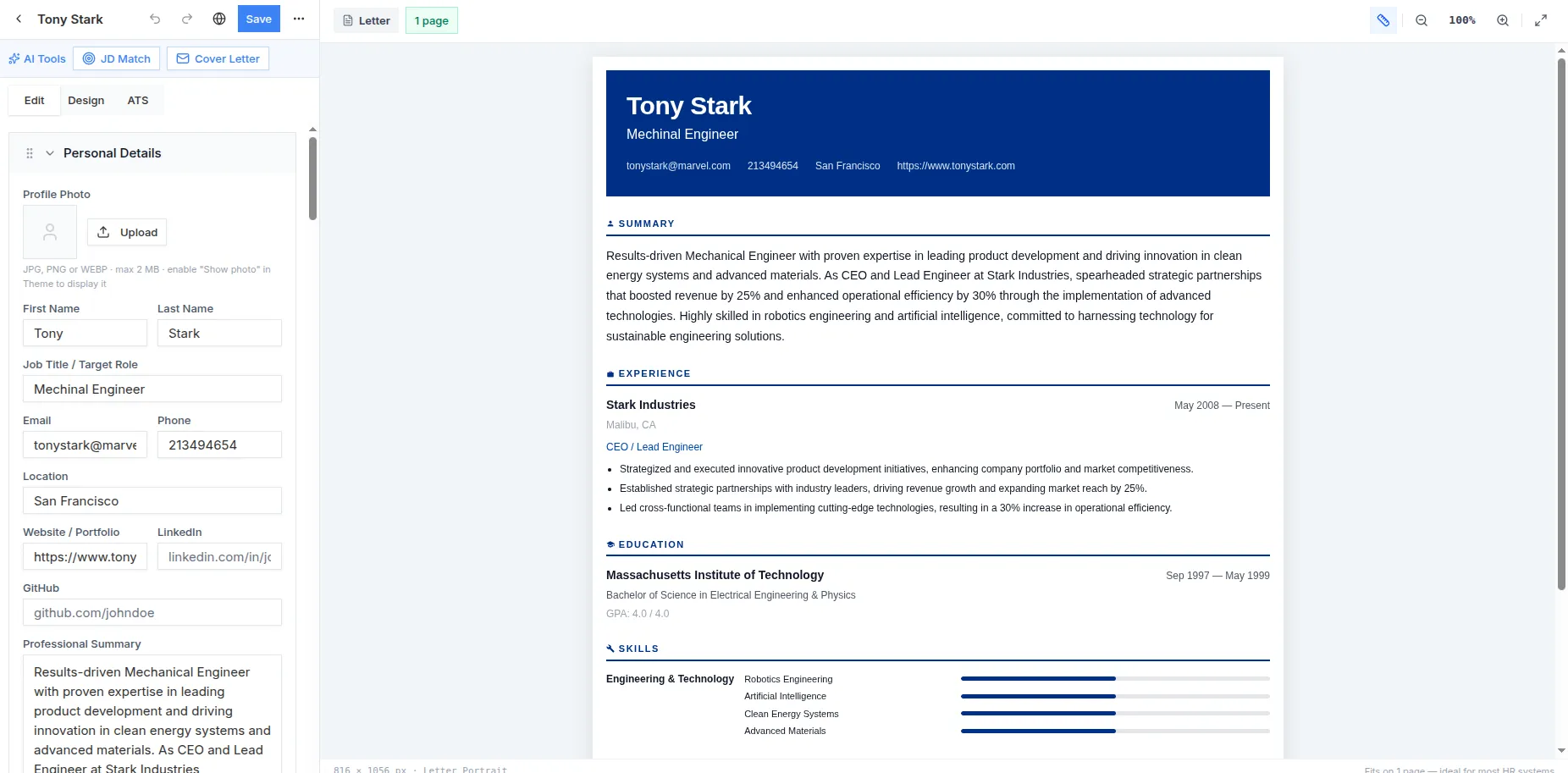
Real screenshot from the live app — sign in free and build yours
Get your resume interview-ready
Your resume is the reason you get the interview. Make sure it passes ATS screening and impresses the hiring manager.