
Updated
CV vs Resume: The Difference, Explained Simply
In the US, a resume is a short, tailored marketing document (1–2 pages) and a CV is a complete academic record (as long as it needs to be). In most of the rest of the world, “CV” just means resume. Here is exactly which one you need and when.
Side-by-Side Comparison
What “CV” Means Around the World
Most confusion about CV vs resume is really a translation problem. The same word refers to different documents depending on where the employer is.
United States & Canada
"Resume" and "CV" are different documents. Employers expect a 1–2 page resume; a CV is only for academia, research, and medicine. Sending a 6-page CV to a corporate job reads as not understanding the market.
United Kingdom, Ireland, New Zealand
"CV" is simply the standard word for what Americans call a resume — a concise 2-page document. Job postings asking for a CV expect brevity, not an academic dossier.
Europe (EU)
"CV" is the universal term, typically 1–2 pages. Some countries (Germany, for example) traditionally include a photo and personal details — check local norms. The Europass format exists but is rarely required anymore.
Australia, India, South Africa
The terms are used interchangeably. Expect 2–3 pages. In India, "CV" and "biodata" both circulate — follow whatever the specific posting asks for.
How to Turn a CV Into a Resume
Leaving academia for industry? The hardest part is deleting. Your CV proves depth; your resume must prove relevance — to a recruiter who will give it 7 seconds.
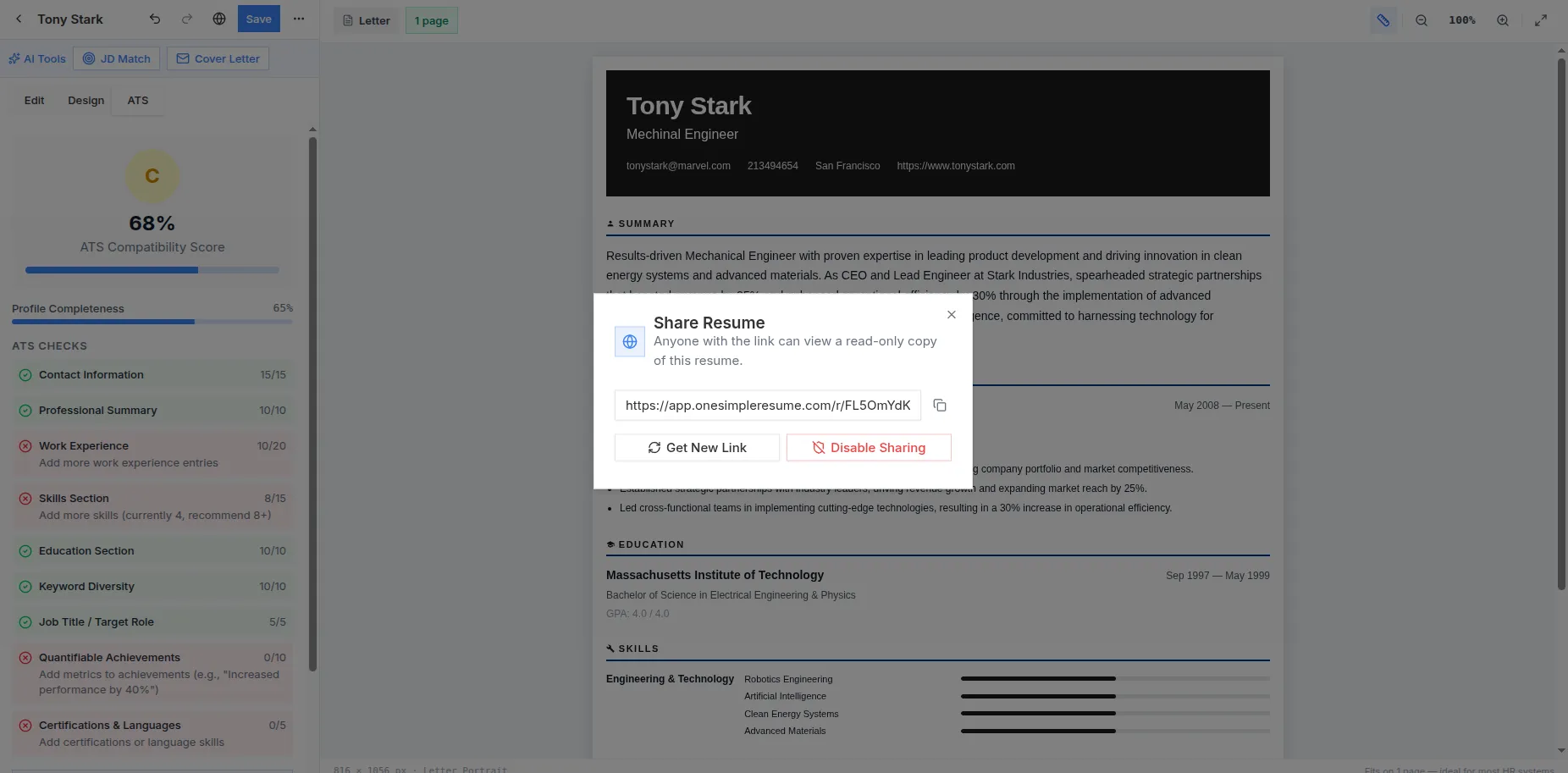
Real screenshot from the live app — sign in free and build yours
CV vs Resume FAQ
Is a CV the same as a resume?
In the US and Canada, no — a resume is a short, tailored 1–2 page document for job applications, while a CV (curriculum vitae) is a complete academic record with no length limit. In the UK, Europe, and most of the world, "CV" is simply the local word for a resume.
Which one do I need for a job application?
Read the posting and match the country. US/Canada private sector: resume. US academia, research, or medical faculty roles: CV. UK/Europe posting asking for a CV: send a concise 1–2 page document — what Americans would call a resume.
What does CV stand for?
Curriculum vitae — Latin for "course of life." That origin explains the difference: a CV chronicles an entire career, while a resume (from the French for "summary") condenses it.
Can I use a resume template for a CV?
For international "CV" requests, yes — a clean resume template is exactly right. For an academic CV, use a plainer format with sections for publications, research experience, grants, teaching, and conference presentations, and let it run as long as your record requires.
Need the Resume Version? Build It Free
One Simple Resume gives you 17 ATS-friendly templates and a guided editor — perfect for condensing a CV into a sharp 1–2 page resume. No account needed.