
Updated
How to Write a Cover Letter That Gets Interviews in 2026
Most cover letters are ignored because they follow a boring, generic template. This guide shows you exactly how to write one that stands out — with structure, real opening line examples, common mistakes to avoid, and word-for-word guidance for every paragraph.
Do You Need a Cover Letter?
Short answer: yes, unless the job posting explicitly says not to include one.
While some recruiters skim or skip cover letters, others use them as the primary deciding factor between two equally qualified candidates. A well-written cover letter can turn a borderline candidate into a top pick. A poorly written one can disqualify a strong candidate.
When applying through an ATS (online portal), a cover letter often won't be scanned by the machine — but it will be read by a human if you make it past screening. For referrals, cold outreach, and smaller companies, a strong cover letter can be the deciding factor.
Cover Letter Structure
Your name, contact info, date, and recipient details (name, title, company, address when known). Match the visual style of your resume header.
Use the same fonts and styling as your resume to create a cohesive application package.
Address the hiring manager by name when possible. "Dear [First Name] [Last Name]" is always best. "Dear Hiring Manager" only as a last resort.
Find the hiring manager's name on LinkedIn, the company website, or by calling the company directly. The effort signals serious interest.
The most critical part. State the role you're applying for, your most impressive credential, and a strong signal of why you want this specific company. Hook the reader immediately.
Never start with "I am writing to apply for..." Start with your strongest differentiator.
Your highest-value accomplishment relevant to this role, told as a story. Situation → Action → Result. Pick one thing you've done that directly maps to what they need most.
This is not a list of your duties. It's a specific story about specific impact. One compelling story beats five generic ones.
Why this company specifically. Show you've done your research — product direction, recent news, culture, mission. Connect what you know about them to what you offer.
Generic cover letters are obvious and ignored. One sentence of genuine company knowledge goes further than three paragraphs of generic enthusiasm.
Restate your interest, request the interview explicitly, and thank them for their time. Confident but not arrogant. Specific next step rather than passive waiting.
Say "I'd welcome the chance to discuss how I can contribute to [Company]." Don't say "I hope to hear from you."
"Sincerely," or "Best regards," followed by your full name.
Skip "Yours truly" — it's outdated. Keep the sign-off professional and clean.
Opening Lines: Bad vs. Good
“I am writing to apply for the Marketing Manager position.”
Wastes the first line on something they already know.
“My name is Jane Smith and I am very interested in this role.”
They know your name from the header. "Very interested" signals nothing.
“I saw your job posting on LinkedIn and would like to apply.”
Tells them nothing useful. Every applicant saw the posting.
“I believe I would be a great fit for this position.”
Claiming fit without evidence is meaningless — anyone can write this.
“With my 5 years of experience...”
Leads with a number that means nothing without context.
“After leading Acme Corp's email marketing program from $200K to $1.2M in annual revenue, I'm ready to bring that same growth-focused approach to [Company]'s marketing team as your next Marketing Manager.”
Opens with a specific, quantified achievement directly relevant to the role.
“When [Company] launched [Product Name] last year, I used it every day to manage our 40-person design team — and I kept thinking: I want to be part of building what comes next.”
Shows genuine product knowledge and authentic motivation.
“Three backend engineers I've managed have since been promoted to senior roles at FAANG companies. I'd like to bring that same investment in engineering excellence to [Company] as your next Engineering Manager.”
Specific, surprising, and relevant — creates immediate curiosity.
7 Cover Letter Mistakes to Avoid
Repeating your resume
Your cover letter explains why — your resume shows what. Never list the same bullets. Tell the story behind your best achievement.
Making it too long
One page maximum. Ideally 3–4 short paragraphs. Recruiters won't read essays. Every sentence must earn its place.
Generic company praise
"Your company has a great culture" is worthless. Reference a specific product, initiative, press release, or value statement and explain why it resonates.
No call to action
End with a clear, confident invitation: "I'd love to schedule a conversation to discuss how I can contribute" — not passive hope that they'll respond.
Not customizing for the role
Every cover letter must be customized. At minimum: the company name, the role, the hiring manager's name, and one company-specific detail. Templates are starting points — not final drafts.
Focusing on what you want
"I want to grow my skills" signals self-interest. Flip every sentence: instead of what you'll gain, emphasize what you'll contribute.
Typos and grammatical errors
A single typo can disqualify you. Proofread three times. Read aloud. Have someone else check it. Typos in a cover letter signal carelessness — exactly the trait no employer wants.
Cover Letter Checklist
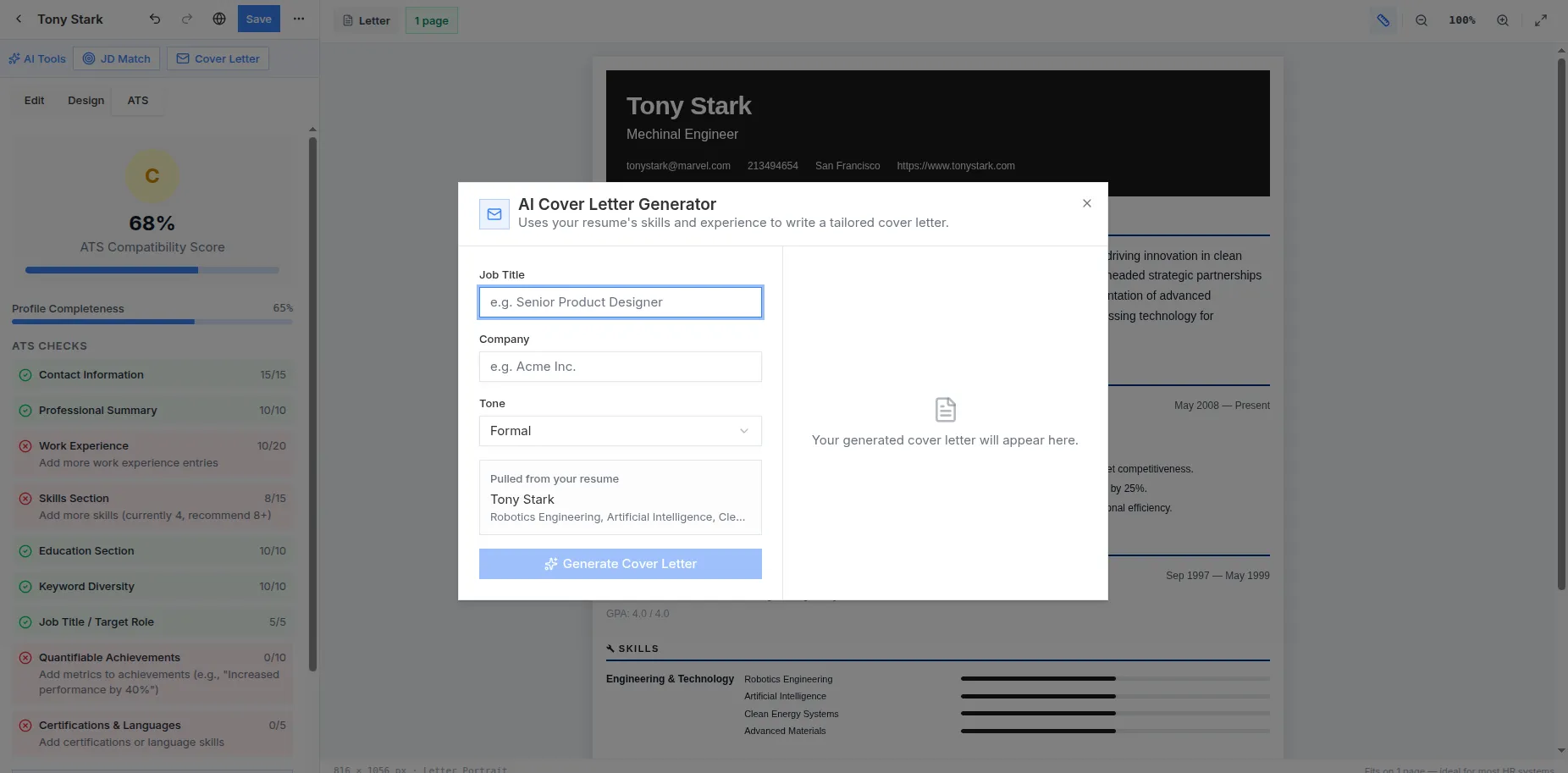
Real screenshot from the live app — sign in free and build yours
Write Your Cover Letter Now
One Simple Resume includes matching cover letter templates for every resume. Write, edit, and download your cover letter alongside your resume — completely free.