
Updated
Letter of Interest: What It Is and How to Write One
Sometimes the company you most want to work for isn't hiring — or hasn't posted the role yet. A letter of interest is how you reach out anyway: a short, targeted introduction that opens a relationship instead of completing an application. Here's how it differs from a cover letter, the structure that works, and a full example.
Letter of Interest vs. Cover Letter
They look similar but serve different moments in a job search — mixing them up is the most common mistake with this letter type:
| Aspect | Cover Letter | Letter of Interest |
|---|---|---|
| When you send it | In response to a specific, currently open job posting | Unprompted — no open posting exists, or you're not sure one does |
| What it references | The exact job title and requirements from the posting | The company itself — its work, mission, or a specific team you admire |
| Where it goes | Attached to an application through the company's job portal | Emailed directly to a hiring manager, department head, or recruiter |
| Its core question | "Why am I right for this role?" | "Why do I want to work at this company, and what would I bring?" |
Applying to an actual posting? You want a cover letter instead — see also cover letter examples.
The 5-Part Structure
Specific opening — no open-ended greeting
Name the company and exactly why you're writing to them specifically, not companies in general. "I've followed [Company]'s work on [specific project/product/initiative] for the past year" beats "I am interested in career opportunities." Vague opens are the single biggest reason these letters get skimmed and discarded.
What draws you to this company
One or two sentences on something concrete and true: a product you use, a mission you align with, a recent announcement, a team you'd want to be part of. This section proves you researched them specifically — not that you're mass-emailing a list of companies.
What you'd bring
Two to three sentences translating your background into value for them, even without a specific role to target. Focus on the type of problem you solve and one concrete result, not a full resume recap — the goal is to make them curious enough to open your resume, not to replace it.
A specific, low-pressure ask
State clearly what you want: a short call, being kept in mind for future openings, or a chance to discuss a specific team's needs. Vague closes ('let me know if anything comes up') get ignored — a concrete, low-commitment ask is far more likely to get a reply.
Professional close with next-step ownership
Thank them for their time, note you've attached your resume, and say you'll follow up in a week if you don't hear back — then actually do it. A stated, kept follow-up plan is what separates letters that get read from ones that vanish into an inbox.
Letter of Interest Example
Sent by a marketing coordinator with no open role posted, targeting a specific company and team:
Dear Ms. Whitfield,
I've followed Bramble Outdoor's brand relaunch over the past year — the shift toward user-generated trail content on Instagram has been one of the more interesting brand repositions I've watched in outdoor retail, and it's the kind of work I'd genuinely like to be part of.
I'm a marketing coordinator with three years of experience running social content calendars and community partnerships for a regional outdoor gear co-op, most recently growing our Instagram engagement 140% by shifting from produced content to customer trail stories — a strategy close to what I've seen Bramble build.
I don't see a current opening on your careers page, but I'd welcome a short call to learn more about your content team's plans for next year, or to be kept in mind if a relevant role opens up. I've attached my resume for reference.
Thank you for your time — I'll follow up in about a week if I don't hear back sooner.
Best,
Jordan Ruiz
5 Tips That Actually Get Replies
- Address it to a real name whenever possible — a hiring manager, department lead, or recruiter, found via LinkedIn or the company site. "To Whom It May Concern" undermines the entire premise of a targeted, researched letter.
- Keep it to half a page. This isn't a cover letter answering a job description — it has less to justify and should be proportionally shorter.
- Always attach your resume, even though there's no posting to apply against. The letter opens the door; the resume is what actually gets evaluated.
- Send it by email, not through an ATS portal — there's usually no posting to apply through, and email lets you reach an actual person directly.
- Follow up once, about a week later, with a short, friendly note. Most replies to unsolicited outreach come after a follow-up, not the first message.
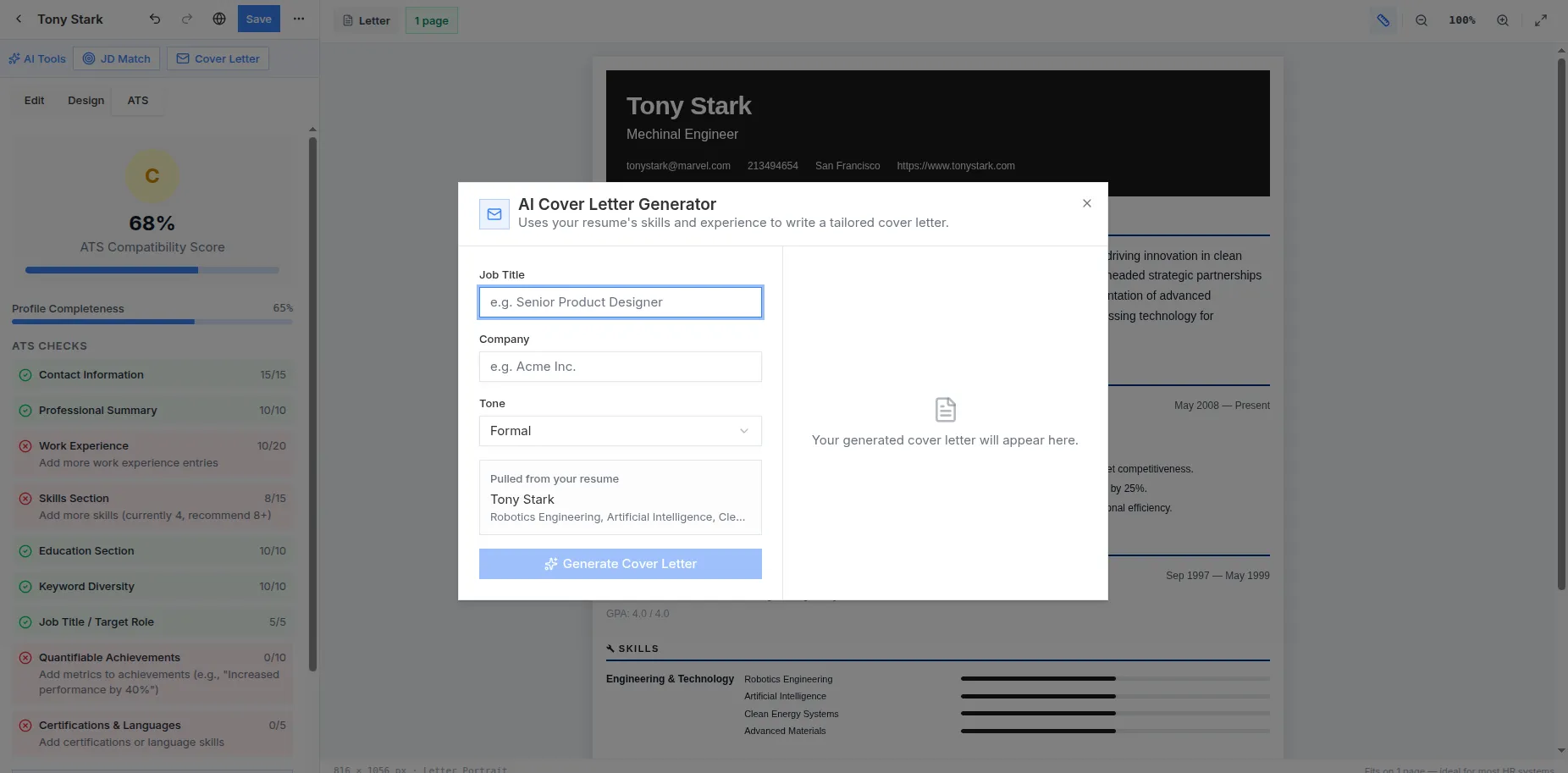
Real screenshot from the live app — sign in free and build yours
Letter of Interest FAQ
What is a letter of interest for a job?
A letter of interest (also called a letter of inquiry, prospecting letter, or statement of interest) is a message sent to a company you want to work for when there's no specific open position you're applying to. It introduces you, explains why that company specifically interests you, and asks to be considered for future opportunities or a conversation.
How is a letter of interest different from a cover letter?
A cover letter responds to a specific, currently posted job and references its exact requirements. A letter of interest is sent unprompted, when no posting exists, and focuses on your interest in the company itself rather than a specific role — it opens a relationship rather than completing an application.
How long should a letter of interest be?
About half a page — three to four short paragraphs. It has less to justify than a cover letter responding to a job description, so it should read shorter and more direct.
Should I attach my resume to a letter of interest?
Yes, always. The letter introduces you and opens the door; your resume is what a hiring manager actually reviews if they're interested. A letter of interest without an attached resume rarely leads anywhere.
Who should I send a letter of interest to?
A specific person whenever you can find one — a hiring manager, team lead, or recruiter at the company, located via LinkedIn or the company's website. A generic "To Whom It May Concern" undercuts the whole point of a targeted, researched outreach letter.
Build the resume to attach with it
A polished, ATS-safe resume ready to send the moment your letter of interest gets a reply. Free, no account needed.