
Updated
How to Explain Employment Gaps on a Resume
A gap in your work history is common and rarely disqualifying on its own — what matters is whether you control the narrative with a short, honest label or leave a reviewer to guess. Here's which format handles a gap best, and real wording for six common reasons.
Which Resume Format Handles a Gap Best
Combination (skills-first, chronological second)
Best default for most gaps under 2 yearsLeads with a skills/qualifications summary before the chronological work history, so a reviewer's first impression is your capability, not the timeline. The gap is still visible but no longer the first thing anyone reads.
Functional (skills-grouped, minimal dates)
Longer gaps (2+ years) or multiple gapsGroups experience by skill category instead of by employer/date, with a compact 'Work History' block at the bottom listing employers and years (not months). Reduces visual emphasis on the gap, though some ATS parsers and some recruiters read functional formats as a flag on their own — use it deliberately, not by default.
Chronological with a labeled gap entry
Gaps you can name productively — caregiving, education, a documented projectKeep the standard reverse-chronological format but add a real entry for the gap period, titled honestly (e.g. 'Family Caregiving,' 'Full-Time Caregiver,' 'Independent Study — UX Design') with 1-2 lines on what you did. Turns a blank space into content instead of hiding it.
For a full comparison of every resume format, see the resume format guide.
How to Word the Gap, by Reason
One line is enough. Adapt the wording to your actual situation rather than copying it verbatim:
"Company underwent a workforce reduction; used the transition to complete [certification] and refine my job search toward [target role/industry]."
"Full-Time Caregiver, 2024–2025 — Managed a household transition while caring for a family member; maintained industry knowledge through [specific course/reading/volunteer work]."
"Medical Leave, 2024 — Took time to address a health matter; fully able to resume full-time work." (You are not required to name the condition — a short, neutral line is standard and sufficient.)
"Extended Travel, 2024 — Traveled independently across [region]; developed budgeting, planning, and adaptability skills applied to [relevant transferable skill]."
"Independent Study, 2024–2025 — Completed [certification/course] in [field] to transition toward [target role]; see Education section."
"Active Job Search, 2024–2025 — Focused search on [target role/industry]; maintained skills through [freelance work, volunteering, coursework, or side project]." Pairing this with even small freelance or volunteer work turns an empty gap into a bridge — see our guide on listing freelance and contract work.
Mistakes That Make a Gap Look Worse
A visible blank date range with no context reads as something being hidden, which invites more suspicion than almost any honest explanation would. Recruiters notice gaps; the question is whether you control the narrative or they guess at it.
One line is enough on the resume. A paragraph of justification reads as defensive and takes space away from your actual qualifications — save the fuller story for the interview if it's asked about.
Easily disproven in a background check or reference call, and a discovered fabrication ends the process instantly — far worse than any real gap. Use an honest label (Caregiver, Independent Study, Active Job Search) instead of an invented one.
Listing 'March 2024 – November 2025' draws more attention to the gap's precise length than 'Jan 2024 – 2025.' Year-only formatting is standard practice and slightly softens the visual gap without being misleading.
A one-line, honestly labeled gap almost always reads better than a hidden or fabricated one — recruiters see gaps constantly and rarely treat a well-explained one as disqualifying.
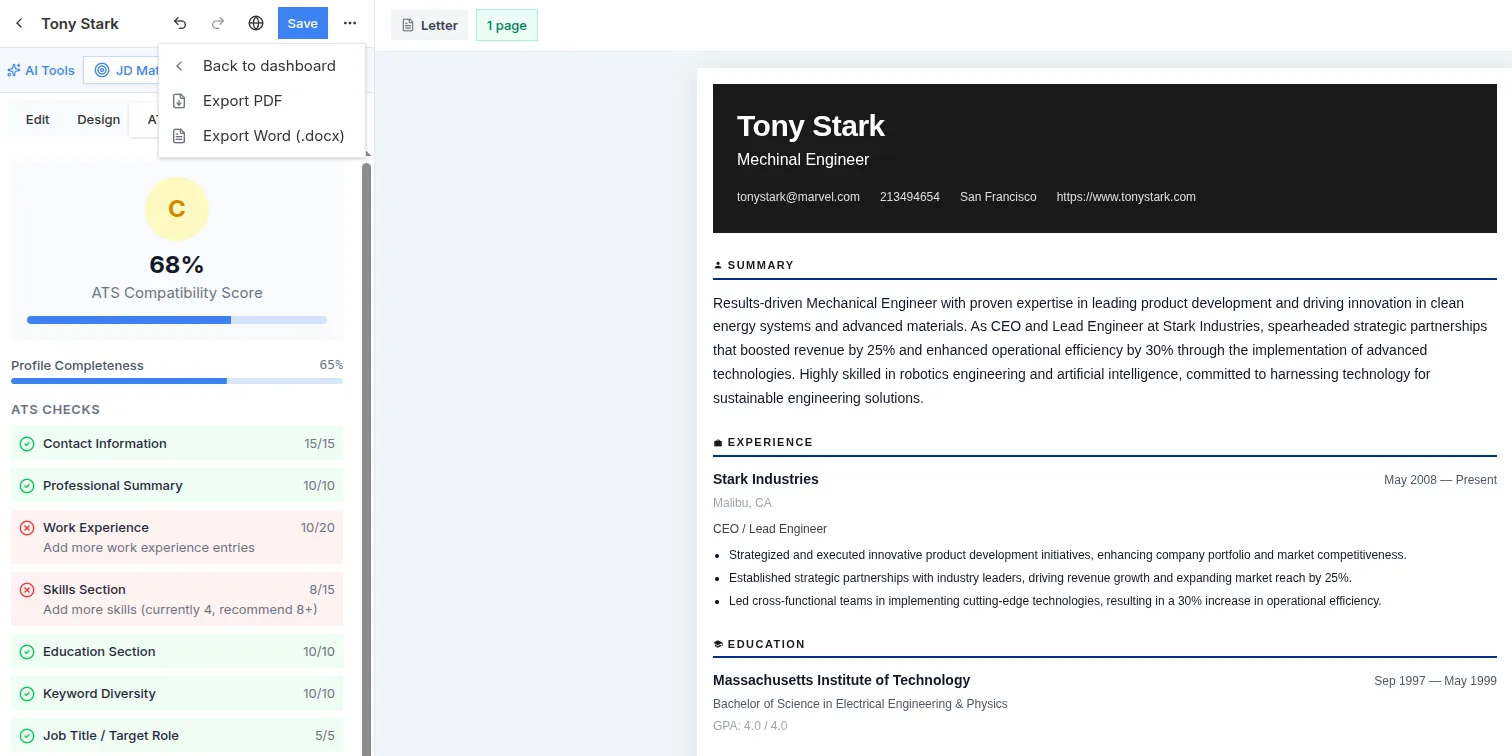
Real screenshot from the live app — sign in free and build yours
Employment Gaps FAQ
Do I have to explain a gap in my resume, or just in the interview?
A short, honest label on the resume (one line, no more) is usually enough — it prevents the gap from being the first question a recruiter has before they've even seen your qualifications. Save the fuller story for the interview if it comes up.
How long of a gap actually needs an explanation?
Gaps under 3-4 months rarely need any special handling — normal job-search timelines cover that. Gaps of 6 months or more benefit from at least a one-line label so a reviewer isn't left to guess.
Should I use a functional resume format to hide a gap?
It can reduce visual emphasis on dates, but some recruiters and some ATS parsers read a fully functional format (no chronological work history at all) as a flag on its own. A combination format — skills summary first, chronological history second — is usually the safer default.
What if I did nothing productive during the gap?
You did more than it feels like — job searching, managing a household, caregiving, and recovering from burnout are all real activities worth a short honest label. The goal is an accurate one-line description, not a fabricated achievement.
Will an employment gap get my resume auto-rejected by ATS?
No — ATS software parses text and keywords, it does not flag or auto-reject based on date gaps. The concern with gaps is entirely about the human reviewer's judgment, not automated screening.
Build a resume that leads with your strengths
Free ATS-friendly templates in combination and functional formats.